
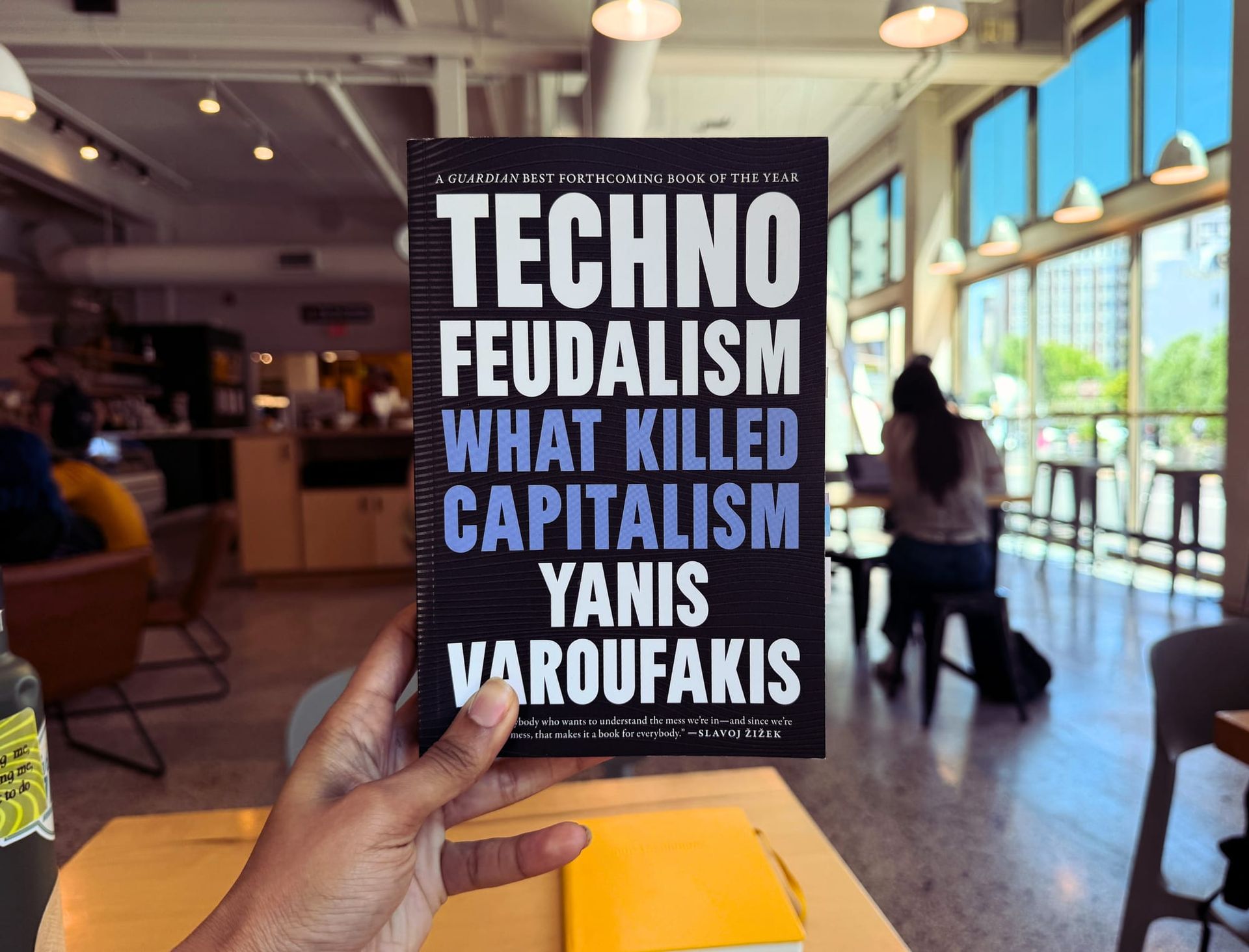
Technofeudalism: What Killed Capitalism by Yanis Varoufakis

A few weeks ago, my freelance client — bless his heart — asked his Claude chatbot to give him the link to a website I texted him the day before. I pulled up the link, then watched quietly as we waited for the plagiarism machine to dig through its archives. We waited, and waited.
Mind you, my client is a smart man. He's spent decades honing a craft, and I admire his skill and discipline. And yet, forty-five seconds went by before I broke the silence and sent the link to him again. The next day, I picked up this book.
The term technofeudalism has caught on yet, but it should. Hard to fight what you can't name, right?
It encompasses the people who've become reliant on AI (or PKMs, or social media) to tell them what to do or how to think. It's the way every website presents you with ads for that new hobby you just started yesterday, as if reading your mind. It's Amazon Alexa, and Flock, and Oura Ring, and how the more smart things you buy, the more you lean into the convenience of technology, the dumber you feel.
This is how our brains get sold back to us. (On a monthly subscription, of course.)
Varoufakis penned Technofeudalism to chronicle how we got here, and think aloud with other very smart people about how to get out. And yet, the discussions of these very smart people are near-impossible to replicate in my regular life, where eggs cost $10 and everybody's too caught up in their frenetic lives to rant aloud with me about lofty things that can't be solved overnight.
My debut novel is set in a futuristic San Francisco, wherein the tech oligarchy as we know it in 2026 — the one that's currently busy having WWE fights on the White House lawn, treating politics like a playground — was allowed to progress to its logical conclusion: a city dominated by a culture cultivated largely by algorithms, training its citizens to be totally okay with dehumanizing those outside of the dominant tribe. I'm doing a Handmaid's Tale, or perhaps a Mistborn, but with magic and smartwatches and shit.
Around the world, we want desperately to be seen and understood. We want to ask straight questions and get straight answers. Maybe some people asked for AI companions, but in a perfect world we'd have communities that make room for the less socially astute. We'd have systems that flex and bend to meet the needs of the people they serve.
Towards the end of the book, Varoufakis tells us he wrote a novel. After spending 200 pages explaining in excruciating detail how we'd all become the cloud proletariat to a ruling class to tech companies, he struggled to envision what to do about all this without shooting down his own ideas on closer inspection.
What does an author do if he disagrees with everything he writes? My answer was to write a novel populated with characters that each represented one of the various perspectives that were jostling for influence in my mind.
He put into words what I'm trying to do with my novel: I want to understand the ways we're trained to perform for a society not built for us, and what the fuck to do about it. And I can't help but feel like this thread is exactly what American culture tries to train out of us.
We are so close to class consciousness...but also, we're tired.
As I finally surpassed 80,000 words on my manuscript, like a new parent breathlessly bragging to childfree friends about how brilliant her drooling infant is, I've struggled to tamp down my desire to yap constantly about it. Not just the characters (so fun!) and the plot (a masterpiece!), but the messages and themes behind each arc, and their underlying lessons.
Humans learn through storytelling. We tell our toddlers bedtime stories, and teach them about religion sometimes, and make them read the classics. But I think we've lost the plot (pun intended). In the rat race of trying to stay afloat — finding or keeping a job in an economy from hell, finding connection in an increasingly isolated world — lots of men have forgone fiction entirely. An inner world supplemented by nothing but Atomic Habits and hustle culture manuals sounds bleak and lonely, in an outer world that already has both of those in spades.
This obviously isn't a review of Technofeudalism so much as a reflection on the importance of two things: knowing our history, and imagining a better world together, in genuine community. Cole Hastings recently published his first book — one that he wrote specifically for men, one that he hopes will encourage a passion for story. (I'm probably still gonna read it though.)
Tons of YouTubers and celebrities are coming out with books lately, many of which end up being painfully homogeneous, as the technofeudalists hawking AI have made every damn thing. I'm pretty sure Cole used his real human brain for his, though, and I hope that the more we wake up to the bittersweet joys of critical thinking, the more we'll remember how to organize for communities we actually want to live in.






Member discussion