
Thinking way too hard about creators monetizing their terrible relationships

On every major platform (but mostly TikTok), you can find a cohort of women who, intentionally or otherwise, garner attention and sometimes fame from posting their partners' weird behavior online.
At best, "weird" can mean garden-variety manbaby nonsense, such as having a tantrum when their favorite shirt isn't clean. At worst, the poster describes horrifying behavior, with an even bleaker tone of an exhausted mother. It's awful to see, and naturally, her comment section will be filled with concerned women.
Many of those women will tell her that they've been in her situation. That it quickly escalated from emotional abuse into physical. That they didn't think it would happen to them. That it started in the exact same way she's describing right now. That she should maybe set up an emergency plan, while she still can.
And, invariably, she will respond by calling them nosy, dramatic, weird, then turn off her comments. The next day, she will probably post a cutesy slice of life moment with her hubby just to prove how actually-totally-perfect her marriage is.
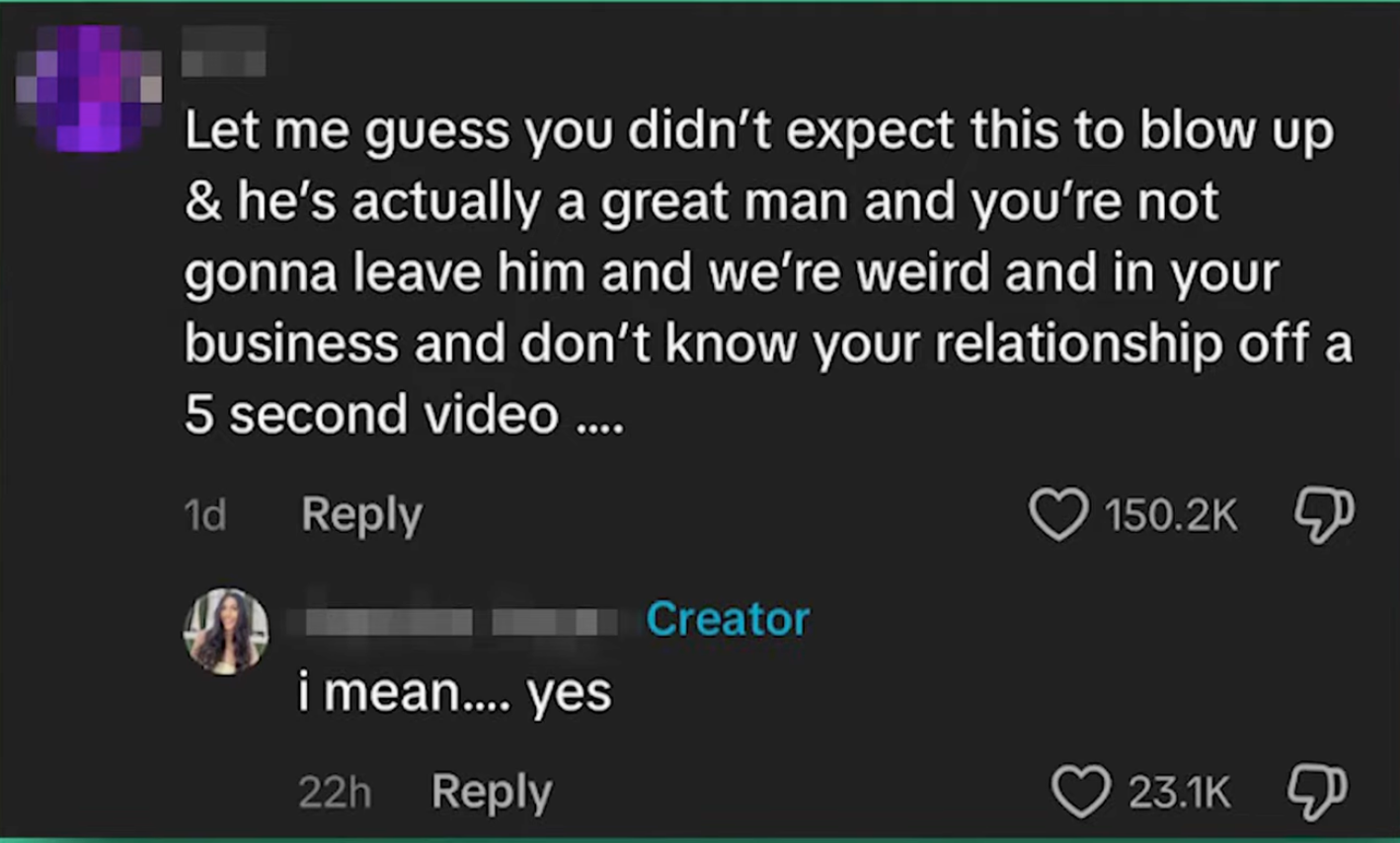
This isn't a post denigrated those women's experiences. They're right, after all; I don't know their lives, and neither do you! But I just can't get this phenomenon out of my head.
What are they getting out of this?
As a recovering marketing shill my first thought was, ragebait views and watchtime revenue, duh. But hardly any of these creators go viral enough to earn much income, especially on oversaturated platforms like TikTok. Sure, some of them try to launch an influencer career, maybe even pivot their personal account into a family channel content, with their terrible husband as its centerpiece.
But we all see the risk in that, right? Using your family as props to curate an online narrative of victimhood might have a few unintended consequences in your real life relationships. Strange as it is, on the rare off-chance they actually do build an audience this way, I wouldn't wish a clout chasing-related divorce on any of them.
My other hypothesis seems a little more promising.
It's "witnessing" gone wrong.
Anyone who's been through severe trauma can attest that having a witness—a friend, a therapist, someone to acknowledge and empathize with our suffering—can change our trajectory when it comes to healing, or at least moving on.
Jung described the archetype of the Witness as essential to psychological transformation; having our pain seen and heard erodes its sharp edges, allowing us to integrate it, learn from it, and ultimately accept it. He argued that the absence of a witness in this context leads to a festering complex[^2]—ruminations, projections, re-enacting the harm onto others, etc.
In Jung's era, we turned to therapy, in-person communities, or religious leaders to help us meet this need. But he couldn't have foreseen social media rising up as en endless pool of potential witnesses, crowdsourced from all over the world, sometimes completely by accident. You could almost call our feeds a pseudo-collective consciousness fits in our pockets (one that’s centered around a black box algorithm none of us ever truly consented to, but that’s a post for another day).
What witnessing is
Having a pocket tribunal can be an incredible leg-up.
Last October, one creator on Threads vented about her husband's insistence on hosting a birthday party, despite his pattern of doing absolutely nothing to organize them. I was one of over 550,000 witnesses encouraging her to let him throw the party on his own. She did. When guests arrived and food wasn't prepared, gifts weren't wrapped, and chaos enveloped every corner of their home, she "walked off to admire the walls."

Almost half a year later, women still use that phrase as encouragement to release the conditioning to step in and save men from the consequen(ces of their poor decisions.
Did this example of witnessing make her filthy rich and an household name? No, but if made your life easier; the husband ultimately saw the error of his ways and has reportedly started planning his own shit.
What witnessing isn't
The difference between Sherlocked's situation and our lamenting women? Nothing happens.
She posts her struggles, people chime in to encourage her to take action, and she just...doesn't. If anything, her only action is to chastise her witnesses for responding to something she posted publicly on the internet. (Venting in private is what diaries are for, but here we are.)
Social media presents an opportunity to monetize our archetypal need for witnessing while stripping out its transformative function, ie. publicly posting as if you want acknowledgment, but rejecting the rest (the advice to leave).
This creates a perverse inversion of the role where commenters answer the call, but the platform’s structure—particularly most algorithms’ preference for negativity and sensationalism—rewards consistent drama and punishes both sides for completing the pattern. Commenters are rejected for trying to fulfill their role, posters are incentivized to maintain their suffering.
Banet-Weiser, S., & Reinis, S. (2026). The rage of tradwives: Affective economies and romanticizing retreat. Feminist Theory, 27(1), 50–66. https://doi.org/10.1177/14647001251371971
Stein, M. B. (2006). Jung’s map of the soul: An introduction (9. print).
Member discussion